Theorem [efr-55CC]
Theorem [efr-55CC]
Let \mathcal {M} be a monoidal category, and let \mathcal {C} be a category with an \mathcal {M}-action.
Then there is a pseudo double category \mathsf {\mathbb Para}_\mathcal {M}(\mathcal {C}), with
- \mathsf {\mathbb Para}_\mathcal {M}(\mathcal {C})_0 = \mathcal {C}
- \mathsf {\mathbb Para}_\mathcal {M}(\mathcal {C})_1 = \mathcal {M} \times \mathcal {C} \downarrow \mathcal {C}, with domain and codomain given by the two projections to \mathcal {C}
- The identities map \mathcal {C} \to \mathcal {M} \times \mathcal {C} \downarrow \mathcal {C} is given by (I, 1_\mathcal {C}, 1_\mathcal {C}, \lambda ), where \lambda : I \cdot - \to - is the left unitor of \mathcal {M}.
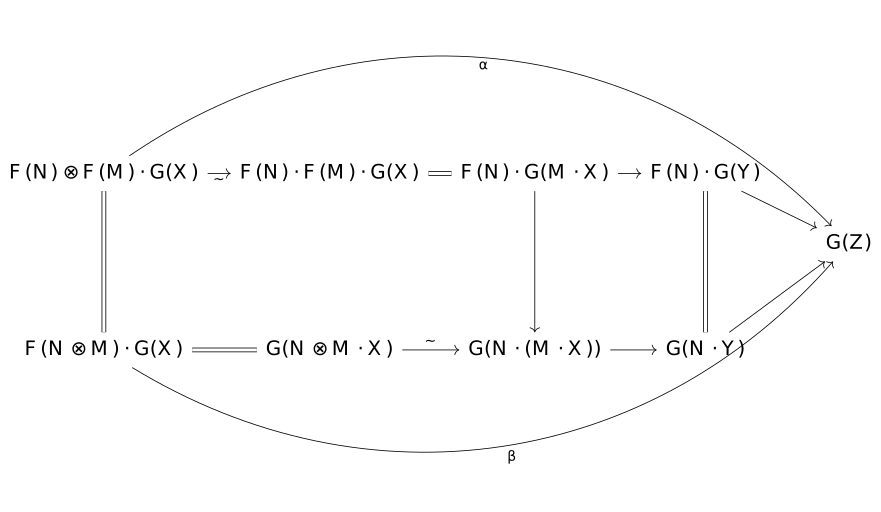
- The horizontal composition map is the composition in \mathsf {Para}: given M \cdot X \to Y, N \cdot Y \to Z, their composite is given by (N \otimes M) \cdot X \cong N \cdot (M \cdot X) \to N \cdot Y \to Z. The horizontal composition of 2-cells is defined analogously.
Moreover, if \mathcal {C} \to \mathcal {D} is strict homomorphism of \mathcal {M}-modules, there is an induced pseudofunctor \mathsf {\mathbb Para}_\mathcal {M}(\mathcal {C}) \to \mathsf {\mathbb Para}_\mathcal {M}(\mathcal {D}). If \mathcal {N} \to \mathcal {M} is a strict monoidal functor, then regarding \mathcal {C} as an \mathcal {N}-module along this map, there is an induced pseudofunctor \mathsf {\mathbb Para}_\mathcal {N}(\mathcal {C}) \to \mathsf {\mathbb Para}_\mathcal {M}(\mathcal {C}). These combine into a 2-functor \mathsf {Act}_s \to \mathsf {PsDbl}_s between the 2-category of actions and strictly linear functors and the category of pseudo double categories and strict double functors. This functor preserves (strict) limits.