Remark [efr-KMX6]

Since \overline {(-)} preserves both global products and fiberwise ones, it induces both a fiberwise monoidal structure and a "global" monoidal structure on \overline {\mathcal {D}_0}. Here we only use the global one. If \mathcal {C} were Cartesian, the global one would be induced from the local one by, given maps \bar {X_1} \to \bar {X_2}, \bar {Y_1} \to \bar {Y_2}, pulling each of them back along the square
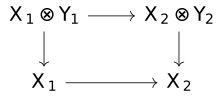
(and the analogous one for Y) and tensoring them over X_1\otimes Y_1. In a Markov prefibration, of course, these pullbacks are not unique unless X_1 \to X_2 is deterministic, but there are "canonical" lifts given by tensoring globally with the (fiberwise) unit map over Y_1 \to Y_2, and the global tensor is indeed given by the tensor of these canonical lifts (this doesn't provide a noncircular definition of the global tensor, of course). This provides a consistency relation between the two tensor products. Again, we will not dwell on this point.