Let \mathcal {C} be a symmetric monoidal category. A premarkov structure on \mathcal {C} is a wide symmetric monoidal subcategory \mathcal {C}' \subseteq \mathcal {C}---that is, a class of morphisms which contains all identities and structural isomorphisms, and is stable under composition and monoidal products---so that the monoidal category \mathcal {C}' is Cartesian.
Given a premarkov structure\mathcal {C}' \subseteq \mathcal {C}, there is a unique Markov structure on \mathcal {C} so that each morphism in \mathcal {C}' is deterministic.
Given a Markov structure, \mathcal {C}_\mathrm {det} \subseteq \mathcal {C} is a premarkov structure.
A premarkov structure has the form \mathcal {C}_\mathrm {det} for some Markov structure if and only if it is maximal.
The existence part first claim is clear: \mathcal {C}' acquires a unique Markov structure since it is Cartesian, and the inclusion of that Markov structure into \mathcal {C} gives a Markov structure on \mathcal {C}. Conversely, suppose \mathcal {C} is a Markov category and \mathcal {C}' \subseteq \mathcal {C}_\mathrm {det} is a class of deterministic morphisms which is still Cartesian. This means the projections X \otimes Y \to X,Y still exhibit X \otimes Y as a product in \mathcal {C}'. But since the pairing are the unique map lifting two given maps A \to X,Y, the pairing must be preserved by the inclusion \mathcal {C}' \to \mathcal {C}_\mathrm {det}. Since the canonical Markov structure is given as a pairing, this means the markov structure induced by \mathcal {C}' \to \mathcal {C} must agree with the one given by \mathcal {C}_\mathrm {det}, which is just the original one.
Now suppose \mathcal {C}_\mathrm {det} \subseteq \mathcal {C}' \subseteq \mathcal {C}, where \mathcal {C}' is some larger premarkov structure. By the argument above, they must generate the same Markov structure on \mathcal {C}. But again, this implies that every map in \mathcal {C}' is deterministic for this Markov structure, so we have \mathcal {C}_\mathrm {det} = \mathcal {C}'. This finishes the proof.
Thus we have the following alternative definition of Markov category:
A Markov category is a semiCartesian symmetric monoidal category \mathcal {C} equipped with a maximal symmetric monoidal wide subcategory \mathcal {C}_\mathrm {det} \hookrightarrow \mathcal {C}.
This is equivalent to Fritz' definition, in the sense that on a given symmetric monoidal category \mathcal {C}, each Markov structure in the classical sense determines uniquely and is uniquely determined by a Markov structure in this sense.
Let F: \mathcal {C} \to \mathcal {D} be a functor between Markov categories.
If F is a Markov functor, it preserves deterministic maps. The oplax monoidal structure on F is necessarily given by the unique one induced on F_\mathrm {det} : \mathcal {C}_\mathrm {det} \to \mathcal {D}_\mathrm {det}.
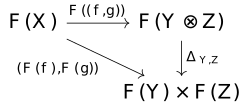
Moreover it preserves independent pairings, in the sense that
commutes, where \Delta is the oplax monoidal structure.
Given a functor F': \mathcal {C} \to \mathcal {D} which preserves deterministic maps and independent pairings in this sense, the comonoid structure on F'_\mathrm {det} makes F into an oplax Markov functor.
A Markov functor is strong if and only if F_\mathrm {det} preserves products.