Lemma [efr-VH33]
- October 30, 2025
-
Eigil Fjeldgren Rischel
Lemma [efr-VH33]
- October 30, 2025
- Eigil Fjeldgren Rischel
Let F: \mathsf {Borel} \to \mathcal {C} be .. Then there is a unique Markov extension \bar {F} over \mathsf {Borel} \to \mathsf {Borel}_{\bar {\Delta }}.
Proof
- October 30, 2025
- Eigil Fjeldgren Rischel
Proof
- October 30, 2025
- Eigil Fjeldgren Rischel
First, note that the Kleisli category \mathsf {Borel}_{\bar {\Delta }} is freely generated by adding morphisms s_A: \bar {\Delta } A \to A for each A, subject to the equations that these are natural in A, unital for the monad structure, and satisfy s_A\mu _A = s_As_{\bar {\Delta }}A (where \mu is the multiplication of the monad).
Let \Delta _omega (\omega ) \to \omega be the map in \mathcal {C} constructed above. We first prove that the resulting F(A)^\omega \times \bar {\Delta }(\omega ) \to F(A) factors over F(\bar {\Delta } A). This factorization will be our chosen \bar {F}(s_A).
Note that the map F(A)^\omega \times \bar {\Delta }(\omega ) \to F(\bar {\Delta } A) is F applied to a map A^\omega \times \bar {\Delta } \omega \to \bar {\Delta } A. This map splits. As above, to show the sampling map factors over this, it suffices to describe the normal form implied by the splitting and show that normalizing first does not alter the sampling map. It is easier here to simply describe the normal form:
- If any a \in A occurs multiple times with nonzero \epsilon _i, combine all of them (replacing those \epsilon _i with zero and adding them to the coefficient of the first occurence of that a)
- Fix some arbitrary a^* \in A and set a_i = a^* whenever \epsilon _i = 0.
Permute both the coefficients and the a_i, ordering first by decreasing \epsilon _i, then by some arbitrary total order on A (note that the set of distinct a_i with the same coefficient must be finite, so this can be done for any total order).
It's clear that the normal forms are in bijection with \bar {\Delta } A. Just as above, we can prove that sampling and normalization followed by sampling agree by identifying fifty percept of the probability mass of the normalized thing, then fifty percent of the rest, etc.
As we have shown above, the map F(X)^\omega \times \bar {\Delta }(\omega ) \to F(X) always factors uniquely over F(\bar {\Delta } X). We take this factorization to be \bar {F}(s_X).
It's clear that this is unital. We now pass to the multiplicativity. Note that the map F(X)^\omega \times \bar {\Delta }(\omega ) \to F(X) is natural for any map F(X) \to F(Y) \in \mathcal {C}. Consider this diagram:
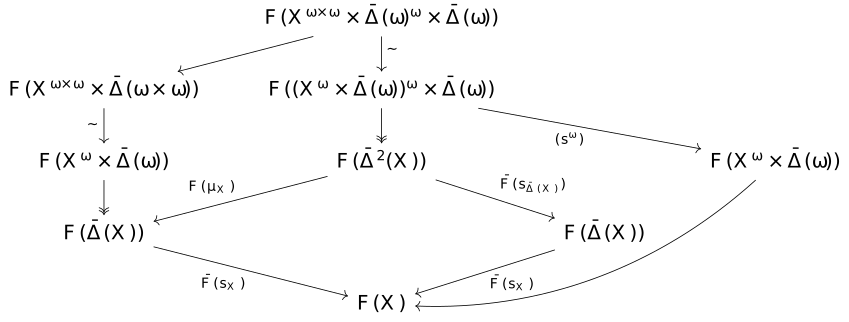
The object is to show that the bottom square commutes. It suffices to consider the two composites from the top object. First consider the right side. By naturality, the outer cell commutes. The map from the top is given by sampling from all the \bar {\Delta }, using the coordinate of the second one to index into the sequence \bar {\Delta }(\omega )^\omega , then taking x_{ij} where i,j are the resulting two natural numbers.
Now consider the left side. The map labeled \mu ' is given by forming the joint distribution on \omega \times \omega obtained by ... The top left cell is simply F applied to a map in \mathsf {Borel}, which is easily seen to commute.
Thus it suffices to show that the two maps F(\bar {\Delta }(\omega )^\omega \times \bar {\Delta }(\omega )) \to F(\omega \times \omega ) given either by using this mutiplication in \mathsf {Borel}, then sampling, or by sampling from everything and combining, agree. But this is essentially the claim that the sampling map is a (infinitary) midpoint homomorphism.
Either here or elsewhere, need to insert this