[lcc-0006]
[lcc-0006]
Let \mathcal {C} be a Markov category. We may define a category of "bundles", which we will denote \mathsf {Bun}(\mathcal {C}), as follows: its objects are deterministic maps X \to I \in \mathcal {C}_\mathrm {det}, and its morphisms are squares
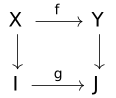
There is a forgetful functor \mathsf {Bun}(\mathcal {C}) \to \mathcal {C}_\mathrm {det} which takes X \to I to I. If \mathcal {C} itself is Cartesian, then this is just the codomain opfibration, and this thing will be a bifibration if and only if \mathcal {C} has pullbacks.
In the Markov case, it's not necessarily sufficient that \mathcal {C}_\mathrm {det} has pullbacks. What is required is, given a diagram of this form where all the maps are deterministic:
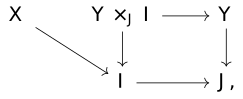
If we impose this condition, \mathsf {Bun}(\mathcal {C}) \to \mathcal {C}_\mathrm {det} becomes not only a bifibration, but a monoidal fibration, and a bifibration with the Beck-Chevalley condition. (The monoidal structure on \mathsf {Bun}(\mathcal {C}) simply being the obvious one). The fibration being monoidal follows from the fact that products of pullback diagrams are pullback diagrams, and the Beck-Chevalley condition holds because it holds for codomain fibrations, and all the morphisms involved in checking it are deterministic