On Random Trajectories in Categorical Systems Theory [lcc-000M]
On Random Trajectories in Categorical Systems Theory [lcc-000M]
The Categorical Systems Theory of David Jaz Myers is a very general language for talking about "systems"---as a special case, dynamical systems. In that framework, the set of trajectories of a system is a representable functor, given by mapping out of some other system. For example, if s: X \to TX is a vector field giving a smooth dynamical system, a trajectory in the usual sense is a map from the dynamical system \mathbb {R} \to T(\mathbb {R}) given by \dfrac {\partial }{\partial x}, ie the system which moves right at constant speed 1.
This framework handles this type of trajectories very well, but it is less clear how to talk about stochastic dynamical systems, which generally have random trajectories.
Let us look for a moment at discrete-time stochastic dynamical systems which are closed (that is, not open, with trivial interface). This consists of a set equipped with a map X \to \Delta (X), thought of as a section of the projection X \times \Delta (X) \to X. A trajectory between such systems is then a map X \to Y so that the obvious diagram commutes.
The first thing we notice is that, if the composite X \to Y \to \Delta (Y) is stochastic, the diagram has no hope of commuting unless either X \to \Delta (X) is also stochastic, or the map \Delta (X) \to \Delta (Y) is stochastic. Thus if we restrict ourselves to deterministic maps between systems, we can't have trajectories typed by deterministic systems in a stochastic system. But this doesn't seem to be desirable---we do want to have some system representing the (random) trajectories in the ordinary sense of a stochastic system, but if we look just at deterministic maps, this won't be possible
But on the other hand, a stochastic map f: X \to Y is also not what we want, because it doesn't allow us to talk about the correlation between f(x) for different x, which is exactly what the system is supposed to talk about.
Indeed, in the ordinary theory of stochastic differential equations and stochastic processes, a solution is not a time-parametrized family of distributions, but a random function. And that is precisely what is necessary in this case as well. When mapping from X \times \Delta (X) \to Y \times \Delta (Y), we need to express the idea that the two values we end up with are not supposed to be independent, but result from the same (random) trajectory applied to the current position x_t and the distribution of possible next states x_{t+1}.
On the other hand, the notion of commutativity we have to ask for is just that two particular joint distributions are the same. Let s: \mathbb {N} \to \mathbb {N} be the successor function considered as a (deterministic) dynamical system, and let s_X: X \to \Delta (X) for some set X be a discrete-time stochastic process. Let x : \mathbb {N} \to X, written x_n be a random function between them. Then we have the random diagram in \mathsf {FinStoch}:
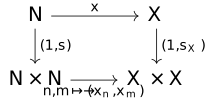
Each path around this diagram describes a random element of \operatorname {\mathrm {Hom}}(\mathbb {N}, \Delta (X \times X)). The first takes n to the distribution on X \times X where the first coordinate is constantly x_n, and the second is distributed according to s(x_n). The other path takes n to the distribution which is deterministically x_n, x_{n+1}. The condition for the random path x_n to be a trajectory of the dynamical system s_X: X \to \Delta (X) is that, for all n \in \mathbb {N}, the two distributions obtained by taking the expectation over the distribution of x agree---which amounts to saying that the conditional of x_{n+1} given x_n is exactly given by s.
Note that the only place where we needed x_n to be a random map, as opposed to a stochastic map, was to define the parallel composite \mathbb {N} \times \mathbb {N} \to X \times X---here we need to express the idea that both of inputs are to be processed according to the same random trajectory, not to be sampled independently from some distributions x_n, x_m \in \Delta (X).
It is not too hard to extend this discussion to trajectories of open systems with a fixed interface \binom {I}{O}, but how to extend this idea to work with the rest of David Jaz Myers' framework seems to be an extremely complicated problem