Monoidal streams as Mealy machines [lcc-0018]
Monoidal streams as Mealy machines [lcc-0018]
See Moore and Mealy machines in CST for a discussion of Mealy machines. Recall from there that we can model a Mealy machine with interface A, in some dynamical systems doctrine, as a map TS \otimes A \to I.
Recall also that, in a monoidal category \mathcal {C}, a monoidal stream from (X_n)_{n\in \mathbb {N}} to (Y_n) is a sequence of objects S_n and morphisms X_n \otimes S_{n-1} \to Y_n \otimes S_n (with the convention that S_{-1} = I).
These seem like they should fit together, and they almost do. The problem is that this is defined in terms of a shift-backwards functor \partial : \mathcal {C}^\mathbb {N} \to \mathcal {C}^\mathbb {N}. We would like to define T in our dynamical systems doctrine so that TS = \binom {\partial ^{-1}S}{S} - then a Mealy machine would indeed be a monoidal stream. The problem is that \partial generally doesn't have an inverse - there is no way to shift a sequence of objects backwards without simply destroying the beginning.
However, if the set of scalars \mathcal {C}(I,I) is a singleton, because \partial is then fully faithful, we can extend the domain and codomain to make it an equivalence. In the concrete situation, this means extending to the subcategory of \mathcal {C}^\mathbb {Z} spanned by the bounded-below sequences (those which are eventually I)
In this case, we compute \int ^S \mathcal {C}(X \otimes S, Y \otimes \partial ^{-1}S) \cong \int ^S \mathcal {C}(X \otimes \partial S, Y \otimes \partial ^{-1}\partial S) \cong \mathcal {C}(X \otimes \partial S, Y \otimes S), where the first isomorphism holds because we're just precomposing our coend with an equivalence of categories, \partial .
Given a tuple \phi : S \to S', X \otimes \partial S' \to Y \otimes S witnessing the identity of two stateful maps, \phi itself is a homomorphism of Mealy machines between them. However, it is not obvious that this relationship goes the other way.
But it does seem as though two Mealy machines will have the same observed behaviour if a morphism exists between them (note that such a morphism must preserve the initial state, i.e this diagram must commute:)
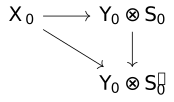
Building on the above observation, it seems quite likely that Mealy machines connected by a homomorphism produce observationally equivalent streams, as in Monoidal Streams for Dataflow Programming, Definition 4.