Triple categories [efr-0035]
Triple categories [efr-0035]
Every category theorist is familiar with the horrible complications associated with higher-dimensional category theory. Even the coherence conditions for essentially two-dimensional objects like monoidal categories or double categories can be annoying to check, and this only becomes more tricky as we pass to higher dimensions. Since the category of controlled processes is a \mathsf {\mathbb Para}-type construction, and should therefore be expected to only be pseudoassociative in at least one of its dimensions, we can't get around confronting this complexity, at least to some extent.
Since verifying the axioms of a pseudo triple category seems hopeless, we must look for a more conceptual approach. Initially, the following idea seems promising
- Observe that categories are models (in sets) of a certain finite limit theory. Internal categories in some other category (for example, the category of categories) are just models in that category.
- Intuitively, we expect pseudo double categories to then be weak models in the category of categories, i.e. functors from the syntactic category which carries the limits to homotopy limits
- Observe that the \mathsf {\mathbb Para} construction preserves homotopy limits. Therefore it will carry a weak internal category in actegories to a weak internal category in pseudo double categories. This will then be a pseudo triple category in a suitable sense.
However, already at step two we encounter serious complications---it is not the case that every pseudo double category, even up to equivalence, can be modeled as a weakly internal category, and in general the relationship between these two classes of objects is somewhat complicated. However, it will turn out that our particular double and triple categories are of a sufficiently nice type (they are isofibrant) that this confusion goes away.
We can package this data a bit more neatly by observing that, instead of asking for a map defined out of "the" pullback, we should instead ask for a choice of pullback diagram and a map out of the given pullback object. Doing so, we realize that most of the data of a category really consists of a diagram of a certain shape (i.e a functor from a certain index category), such that a certain subdiagram is a pullback. The only thing which is not obvious is how to encode the associativity axiom, but this is easily done by adding another object:
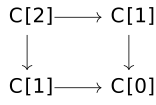
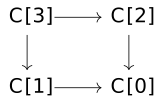
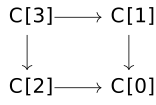
It transpires that, given such a diagram, it automatically extends to the higher simplices in a canonical way. Moreover, taking in these higher simplices matters for higher categorical structures. Thus we introduce the following definition:
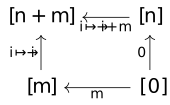
All this would naturally lead you to believe that a pseudo double category is equivalently a weak Segal object in \mathsf {Cat}. This, however, is not true. One way to see this is that the composition operation is (up to equivalence) defined on the homotopy pullback C_1 \times _{C_0} C_1. An object of this category consists of two horizontal morphisms (i.e objects of C_1) and an isomorphism in C_0 between their respective codomain and domain. This seems logical---if two objects in C_0, say x,x' are supposed to be the same if they are isomorphic, how can we not let you compose a morphism ending in one with one starting in the other? But nevertheless such a composition operation is not implied by the structure of an ordinary double category.
It turns out that the simplifying assumption needed to make sense of these problems is one we're happy to make in the situation at hand. Namely, we would like to assume that the functor C_1 \to C_0 \times C_0 picking out the domain and codomain is an isofibration. Recall that a functor p: \mathcal {C} \to \mathcal {D} is an isofibration if, given x in the domain and f: p(x) \to y an isomorphism in the codomain, there is a lift of f to \tilde {f}: x \to \tilde {y}. (Any Grothendieck fibration or opfibration is automatically an isofibration).
These lifts give us the composition-with-f operations we need, but they also simplify the notion of weak Segal object significantly. This is because of the fact that a (strict) pullback of isofibrations is automatically also a homotopy pullback. This means we can simplify the Segal condition to asking that the induced maps C[2] \to C[1]\times _{C[0]} C[1] (where this denotes the strict pullback) are equivalences of categories (recall that C[2] would be a strict pullback if this was an isomorphism of categories), and the analogous statement holds for the higher C[n].
These are of course small parts of the Reedy model structure on simplicial objects, but we will not need to discuss this in detail.
Since trivial fibrations admit strict sections, this will give us the strict composites we were looking for.
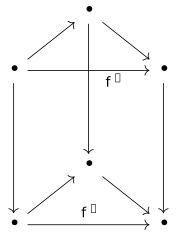
Having found that pseudo double categories are a full subcategory of simplicial categories, we might hope to characterize the essential image. However, they are not all weak Segal objects (as we've seen, this requires isofibrancy), and nor are they strict Segal (this would require discreteness---the strict Segal categories are exactly the strict double categories). There may be a good way of characterizing the image of \mathsf {Dbl}, but the present theorem is suitable for our purposes
See Reference [lack-model-structure-bicats]. Since we are not really interested in this structure, except as we pass through it to construct the objects we're interested in, we will not dwell too much on it. Note however one important point, observed by Buckley in his work on Grothendieck 2-fibrations: all fibrations in his sense have the equivalence lifting property.
Note that there is an obvious inclusion \mathsf {Cat} \hookrightarrow \mathsf {BiCat}_s.
See Reference [johnson-yau-2dim-categories]. We will use this to construct, given the 2-fibration \mathsf {Para}_\mathcal {M}(\mathcal {C}) \to B\mathcal {M} corresponding to an action, a simplicial category classifying the double category \mathsf {\mathbb Para}_\mathcal {M}(\mathcal {C}).
(See again Reference [johnson-yau-2dim-categories]) It is not hard to see that the 2-nerve of a bicategory \mathcal {C} is a weak Segal category, and under the loose identification of weak Segal categories and pseudo double categories, it corresponds to the pseudo double category with horizontal bicategory \mathcal {C} and discrete vertical category. Thus, the nerve of the bicategory \mathsf {Para}_\mathcal {M}(\mathcal {C}) is not quite the gadget we're after---we need to add some vertical morphisms.
One thing we can consider is the simplicial bicategory \mathsf {BiCat}^\mathrm {ps}([n],\mathsf {Para}_\mathcal {M}(\mathcal {C})). This has all the morphisms we want---we just need to thin them out so that the vertical components always live inside \mathcal {C}, i.e. have trivial parameter. It turns out that the way to do this is to consider the pullback of this diagram:
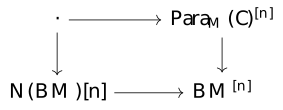
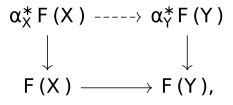
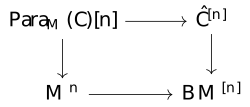
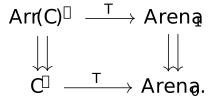
Thus we have a functor from monoidal category actions to isofibrant pseudo double categories (in their guise as Reedy fibrant weakly Segal simplicial categories). Moreover, as it is given as a limit---and, since the limit in question is a pullback of a fibration, and hence a homotopy limit---it will be fairly straightforward to show that this construction preserves internal categories. Hence we will be able to use it to construct a pseudo triple category, as we wanted.