Proposition [efr-003G]
Proposition [efr-003G]
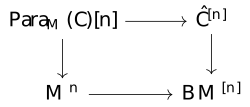
Let \mathcal {M} be a monoidal category which acts on \mathcal {C}. Let \hat {\mathcal {C}} \to B\mathcal {M} be the fibration of bicategories which classifies this action. For each [n] \in \Delta , we have an induced fibration \hat {\mathcal {C}}^{[n]} \to B\mathcal {M}^{[n]}. Let \mathsf {\mathbb Para}_\mathcal {M}(\mathcal {C})[n] denote the fiber of the composite functor \mathcal {C}^{[n]} \to B\mathcal {M}^{[n]} \to B\mathcal {M}^{n+1} over the unique object (*,\dots ,*), where the latter functor is just evaluation at the n+1 objects of [n] (this is not a 2-fibration in general---although it is an isofibration, so the fiber is still well-behaved). Then
- Each such fiber is actually a 1-category
- This construction is functorial in [n], so that \mathsf {\mathbb Para}_\mathcal {M}(\mathcal {C})[-] is a simplicial category
- This simplicial category is a Reedy fibrant weak Segal category. Up to equivalence, it classifies \mathsf {\mathbb Para}_\mathcal {M}(\mathcal {C}), so that the notation makes sense.