Example Monoidal and symmetric monoidal actegories [efr-ARIX]
Example Monoidal and symmetric monoidal actegories [efr-ARIX]
In Reference [actegories-amthematician-capucci-gavranovic], the authors study actegories with extra monoidal structure. Although they do not introduce pseudomonoid actions in a general 2-category, they study actegories internal to monoidal categories, which they call monoidal actegories. It is straightforward to check that pseudomonoid actions in \mathsf {MonCat} agree with their notion: such an action consists of a braided monoidal category \mathcal {M}, an ordinary monoidal category \mathcal {C}, a monoidal functor \mathcal {M} \times \mathcal {C} \to \mathcal {C}, and monoidal natural transformations \mu ,\eta satisfying the coherence equations for an actegory.
(Note that since the functor \otimes appears on one side of \mu , to speak of \mu being a monoidal natural transformation we must have a monoidal structure on \otimes ---this makes \mathcal {M} into a braided monoidal category).
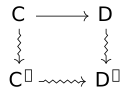
For the case of symmetric monoidal actegories, since \mathsf {SymMonCat} is cocartesian, \mathsf {PsMon}(\mathsf {SymMonCat}) \simeq \mathsf {SymMonCat}. Given two symmetric monoidal categories \mathcal {M},\mathcal {C}, Reference [actegories-amthematician-capucci-gavranovic] show that an action is simply given by a strong symmetric monoidal functor f: \mathcal {M} \to \mathcal {C} (and in this case the action is M \cdot C = F(M) \otimes C). Unwinding this construction we see that \mathsf {Act}_s(\mathsf {SymMonCat}) is bi-equivalent to a category which has as objects strong (but not strict) symmetric monoidal functors C \to C', and morphisms squares