Actegories [efr-NI76]
Actegories [efr-NI76]
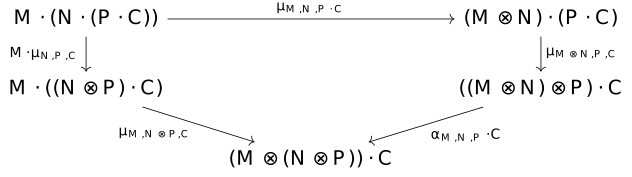
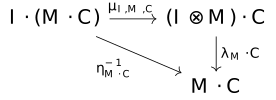
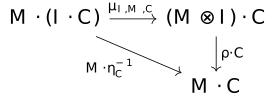
Actegories are a very natural concept, and as one would expect their history goes back a long way. The concept has been considered by Benabou all the way back in Reference [benabou-bicategories], and used many times since them. We will not delve too deeply into their theory here---see Reference [actegories-amthematician-capucci-gavranovic] for a thorough treatment.
Just as pseudo double categories, actegories really make sense in every 2-category, as a weakening of monoid actions.
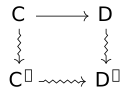
Again, as expected, the notion of strict linear morphism is usually too strict. One can expect an equation like F_m(M) \cdot F_c(C) = F_c(M \cdot C) to hold only up to coherent isomorphism. Let us now make this clear:
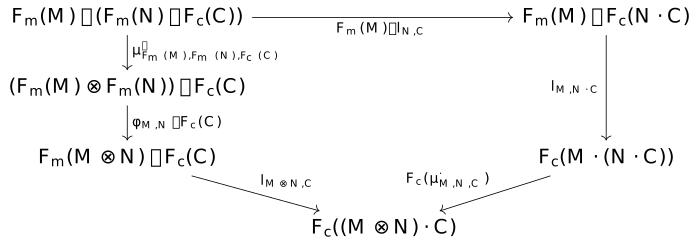
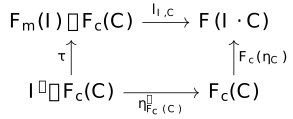
In Reference [actegories-amthematician-capucci-gavranovic], these are defined in two steps: first linear functors for the same \mathcal {M} (those with F_m = 1_\mathcal {M}) are considered. Then, given a strong monoidal \mathcal {M} \to \mathcal {N}, a functorial assignment of an \mathcal {M}-action to every \mathcal {N}-action is constructed, and the full category of actions is defined as the Grothendieck construction of this. There is nothing preventing this from working in the setting of a general 2-category, and it is straightforward to verify that our notion of linear morphism of actions agrees with theirs.