Review of Categorical Systems Theory [efr-0023]
Review of Categorical Systems Theory [efr-0023]
We will give a review of the framework called categorical systems theory, due to Myers (Reference [myers-cst]).
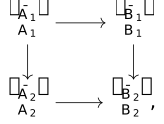
We will write arenas either as {\bar {A} \in \mathcal {A}(A) \choose A \in \mathcal {C}}, or, for brevity when there is no need to discuss the two levels separately, simply with a symbol A. We will also write both {\bar {TS} \choose S} and TS as the situation calls for---there should be no confusion resulting from this.
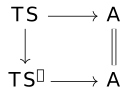
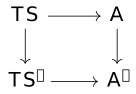
The fibration \int \mathcal {A} \to \mathcal {C} encodes what sort of information can be "indexed over a space", while the section T: \mathcal {C} \to \int \mathcal {A} tells us what sort of information (such as a next step, or a gradient vector) must be produced to give a dynamical system. In this respect, the theory is very similar to the coalgebraic approach to dynamical systems, or systems that "do something", and indeed we have the following:
Of course, coalgebras can already encode systems with input and output---the point of the CST framework is to separate out the input and output of systems so that they can be acted on in a compositional manner.
In another direction, we have the following comparison result:
The first part here (which works, suitably formulated, for any locally Cartesian closed category), is a classical part of the theory of polynomial functors, see eg Reference [kock-poly-classical]. The second part is due to Spivak, see Reference [spivak-poly-abundant]. There is an extensive body of work on the description of interacting (discrete, deterministic) dynamical systems in terms of polynomial functors, see e.g. also Reference [shapiro-spivak-dynamic-operads].
In fact this example works for any monad on the category of sets.
Because of this, one views a generic chart map as a generalized trajectory, of a type given by the domain system. As another example, taking the state space to be \{1,2, \dots , n\} with an update map that carries n to 1, one finds a system which classifies n-periodic trajectories. Similarly, in the smooth case, the system (\mathbb {R}, d/dt: \mathbb {R} \to T\mathbb {R}) classifies solutions of a smooth differential equation (those which extend to infinity). Recent work by Lynch, Myers, Staton, and the author (Reference [lynch-myers-rischel-staton-stoch-clocks]) constructs clock systems for theories of stochastic, discrete-time doctrines, although we will not delve into this here.
Because this thesis is about Markov fibrations, we have chosen to present these ideas in terms of fibrations equipped with sections. Myers' book Reference [myers-cst] actually prefers the presentation in terms of indexed categories. Similarly, we construct a double category of systems which is fibred (in a certain sense) over the double category of arenas. Myers instead displays this as a doubly indexed category \mathsf {\mathbb Arena} \to \mathsf {\mathbb Cat}, which carries lenses to functors and charts to profunctors.
In a recent paper Reference [double-operadic-systems], Myers and Libkind further develop the category theory of what they term double operadic categorical systems theory, which again concerns notions of "composable system" which are described in terms of such doubly indexed category (although for technical reasons, they use the language of right modules in that paper and a somewhat different presentation, the concept is the same.)