Fibrations [efr-3AEA]
Fibrations [efr-3AEA]
In category theory, there are many families of categories indexed by the objects of some other category. For example, for each commutative ring, we have the category \mathsf {Mod}(R). Given a ring homomorphism \phi : R \to S, there is an induced restriction of scalars functor \phi ^*: \mathsf {Mod}(S) \to \mathsf {Mod}(R) (given simply by composing the module structure by \phi ), and this is (contravariant) functorial, assembling into a functor \mathsf {Mod}(-): \mathsf {CRing}^\mathrm {op} \to \mathsf {Cat}.
In most cases, one can not expect strict functoriality as above. From an abstract point of view, it makes sense that one should really ask only for a natural isomorphism \phi ^*\psi ^* \simeq (\psi \phi )^*, up to some coherence conditions. This assembles into a so-called pseudofunctor into the 2-category \mathsf {Cat}.
From a concrete point of view, there are many natural families of categories which arise as pseudofunctors. For example, restriction of scalars always has a left adjoint (extension of scalars, given by M \mapsto M \otimes _R S, viewing S as an R-module via the map \phi )---since adjoints compose (that is, if F \vdash G and F' \vdash G', then FF' \vdash G'G) this must be functorial up to natural isomorphism, but this is the best we can promise.
To avoid the higher categorical algebra involved in working with pseudofunctors, Grothendieck introduced the notion of fibration in Reference [grothendieck-descent-fibrations].
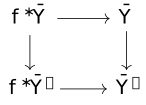
When f: X \to Y and A \in \mathcal {D}_Y, we may write A_X for the object f^*A if there is no chance of confusion. (Compare that the choice of f is also suppressed in the notation A \times _Y X for a pullback)
We will not go into a comprehensive description of the theory of fibrations, but simply give a few basic results. We will give some examples in the next section. For a textbook treatment, see eg. Reference [jacobs-categorical-logic] (chapters 1, 9), or Reference [borceux-handbook] (chapter 8). Note that we will not give a formal definition of the term "pseudofunctor" here. See eg Reference [jacobs-categorical-logic], def. 1.4.4.
Given a pseudofunctor \mathcal {A}: \mathcal {C}^\mathrm {op} \to \mathsf {Cat}, it is obvious that the assignment \mathcal {A}(-)^\mathrm {op} is pseudofunctorial as well (the required natural isomorphisms are just the formal opposites of the ones for \mathcal {A}). Applying this through the equivalence of fibrations and pseudofunctors leads to the fiberwise opposite of a fibration. Explicitly: