Example [efr-IAFO]
Example [efr-IAFO]
Kl(\Delta )^\to is a Markov fibration. We have already seen that it is a Markov prefibration, and that the map from the coreflection is full. So it suffices to prove faithfulness. Consider a map in {Kl(\Delta )^\to |_\mathrm {det}}, given by a diagram
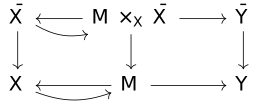
We can factor the section X \to M as X \to X \times Y \to M, where the first map is just the pairing and the second is a conditional distribution. This induces a factorization of the lift \bar {X} \to M \times _X \bar {X} over \bar {X} \to \bar {X} \times Y. By composing the map M \times _X \bar {X} \to \bar {Y} with this factorization to build the map \bar {X} \times Y \to \bar {Y}, we have found a new representative for the same map.
Hence every map over X \to Y has a representative where the residual is X \times Y. We would like to argue that, since the map \bar {X} \times Y \to \bar {Y} is given by the conditional distribution of the composite map \bar {X} \to \bar {Y}, it is uniquely determined by it, and thus if two distinct maps in \overline {Kl(\Delta )^\to |_\mathrm {det}} have the same underlying map in Kl(\Delta )^\to , they must have equal representatives of this form, and so be identified in the coreflection (which must therefore be isomorphic to Kl(\Delta )^\to ). But of course, the two maps may only be almost certainly equal.
In this case, there is a simple fix: instead of taking X \times Y as the residual, take the subset S given by those pairs (x,y) where y has positive probability given x. The pairing factors over this, of course, and two maps \bar {X} \times _X S \to \bar {Y} which give the same distribution \bar {X} \to \bar {Y} really must have the same value on every point. This proves that \mathsf {SChart}(Kl(\Delta )^\to ) \to (Kl(\Delta ))^\to is faithful and hence an isomorphism.