Markov Fibrations [efr-U4RA]
Markov Fibrations [efr-U4RA]
Recall that, given a functor R: \mathcal {C} \to \mathcal {D} with left adjoint L, there is a "standard resolution" of any object X \in \mathcal {C}, given by the "cofork" LRLRX \rightrightarrows LRX \to X, where the two parallel maps are the two possible applications of the adjunction counit. The adjunction is monadic if and only if this is always a coequalizer, in which case the RL-algebra corresponding to X is RLRX \to RX---conversely, given an algebra \alpha : RLA \to A, there are two parallel maps LRLA \rightrightarrows LA (given by L(\alpha ) and the counit,) and the object in \mathcal {C} corresponding to this algebra is given by this coequalizer.
As a generalization of this, if this coequalizer exists for every algebra, they form a left adjoint to the canonical functor \mathcal {C} \to \mathsf {Alg}_\mathcal {D}(RL). Since we have seen that the monad of free Markov prefibrations commutes with taking fiberwise opposites, we may hope that such a left adjoint exists---a simple argument shows that, if it is, it is fully faithful, and we may say that those prefibrations in the image are the "fibrations" and define their fiberwise opposite as the fiberwise opposite applied to their underlying algebras. Although it turns out to not be quite so simple, we will take this idea as our starting point.
In what follows, we will denote the monad \overline {(-)}|_\mathrm {det} simply by \operatorname {Free} to avoid too many complicated nestings of overlines and parentheses.
The terminology "presents a Markov fibration" is justified by the following proposition.
Let us briefly summarize the relationship between Markov prefibrations, Markov fibrations, and stochastic module fibrations at this stage.
- A stochastic module fibration is a (Grothendieck) fibration \mathcal {D} over \mathcal {C}_\mathrm {det}, equipped with some extra structure involving the whole category \mathcal {C}. Given a deterministic map f: A \to B two objects X,Y \in \mathcal {D}_B, and a map \phi : f^*X \to f^*Y, we can think of this as a map parameterized by the fibers A_b. Given a stochastic section s: B \to A, the stochastic module structure picks out a map X \to Y \in \mathcal {D}_B corresponding to choosing this parameter randomly according to s.
- A Markov prefibration is a category \mathcal {D} over \mathcal {C} with a particular unique lifting property. In the above situation, it gives a unique lift X \to f^*X of s, corresponding to choosing a \in A_b according to s and leaving the x \in X-coordinate unchangd. By composing this lift with \phi , then with the Cartesian f^*Y \to Y, we get a stochastic module structure on the part of \mathcal {D} lying over deterministic maps (which is also a Grothendieck fibration).
Given a stochastic module structure, there is a way of generating a category over \mathcal {C}, by freely adding the lifts corresponding to a Markov prefibration, then quotienting by the relations implied by the stochastic module structure. This does not necessarily yield a Markov prefibration.
A Markov prefibration is called a Markov fibration if it is presented by its underlying stochastic module in the above sense.
We will make use of the following lemma:
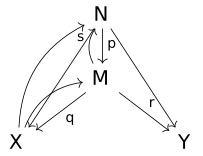
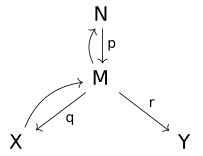
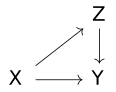
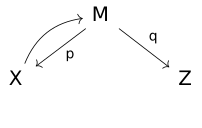
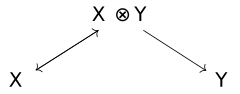
It is not apparent whether weak supports are necessary for \mathsf {SChart}(\mathcal {D}_0) to be a prefibration. We have not found any counterexample, but in general the equivalence relation on charts is fairly complicated, so it is not apparent how to prove the necessity. We will generally not be too bothered about assuming weak supports instead of the more nebulous assumption that \mathcal {D}_0 presents a Markov fibration.
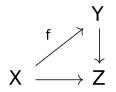
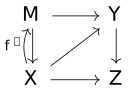
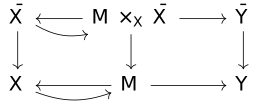
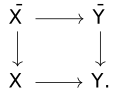
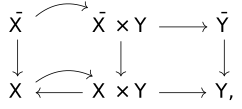
Continuing from Example [efr-CJTH], we have the following trivial case:
It is worth noting that, even in the case where \mathsf {SChart}(\mathcal {D}_0^\mathrm {fop}) is not a prefibration, it may still deserve the name "stochastic lenses". For example the stochastic lenses in \mathsf {BorelStoch} can be seen to contain \mathsf {Optic}(\mathsf {BorelStoch}) as a full subcategory, even though it does not form a Markov fibration (see Theorem [efr-K6NM] below).
Part of the motivation for the theory of dependent optics is to identify a category of stochastic optics which admits all coproducts. If \mathcal {C} is distributive, \mathsf {Optic}(\mathcal {C}) satisfies \binom {A}{X} + \binom {A}{Y} = \binom {A}{X+Y}, but this coproduct fails to exist in general if the two secondary objects are distinct. The idea is that this coproduct \binom {A}{X} + \binom {A'}{Y} should exist as a family indexed by X + Y, where E_x = A for x \in X, and E_y = A' for y \in Y. Our theory accommodates this example under the mild additional hypothesis of extensiveness
In particular, \mathsf {SChart}(\mathcal {C}^\to |_\mathrm {det}), \mathsf {SLens}(\mathcal {C}^\to |_\mathrm {det}) both admit coproducts given simply as coproducts in \mathcal {C}^\to , if \mathcal {C} is extensive.