Markov Fibrations and Stochastic Lenses › Examples [efr-IMLW]
- April 28, 2025
-
Eigil Fjeldgren Rischel
Markov Fibrations and Stochastic Lenses › Examples [efr-IMLW]
- April 28, 2025
- Eigil Fjeldgren Rischel
We have already noted several examples throughout. We'll gather a few more here, and also collect a few scattered throughout to make the picture more clear.
First, let us make explicit the example of optics, as strongly as it can be stated
Proposition [efr-A6YR]
- April 28, 2025
-
Eigil Fjeldgren Rischel
Proposition [efr-A6YR]
- April 28, 2025
- Eigil Fjeldgren Rischel
Let \mathcal {C} act on \mathcal {D}. Then \mathsf {Optic}_\mathcal {C}(\mathcal {D}) := \mathsf {Optic}_\mathcal {C}(\mathcal {C},\mathcal {D}) has a functor to \mathcal {C}. The deterministic part \mathsf {Optic}_\mathcal {C}(\mathcal {D})|_\mathrm {det} admits the structure of a stochastic module fibration. There is an isomorphism \mathsf {Optic}_\mathcal {C}(\mathcal {D}) \to \mathsf {SChart}(\mathsf {Optic}_\mathcal {C}(\mathcal {D})|_\mathrm {det}).
If \mathcal {D} is itself symmetric monoidal and the action is symmetric (meaning it is given by M \cdot A = F(M) \otimes A for some symmetric monoidal functor F: \mathcal {C} \to \mathcal {D}, see Reference [actegories-amthematician-capucci-gavranovic] 5.4.3 and 5.5.12), this stochastic module is symmetric monoidal and the isomorphism is an isomorphism of symmetric monoidal categories.
Proof
- April 28, 2025
- Eigil Fjeldgren Rischel
Proof
- April 28, 2025
- Eigil Fjeldgren Rischel
We have essentially already seen that the deterministic part \mathsf {Optic}_\mathcal {C}(\mathcal {D})|_\mathrm {det} \to \mathcal {C}_\mathrm {det} is a fibration, with maps {A \choose X} \leftrightarrows {B \choose X} over X given by X \cdot B \to A, and with the pullback functors acting by reparametrization. Since a map X \to M \otimes Y with deterministic marginal on Y is always equal to the independent pairing of X \to M, X \to Y, we can slide the former through and identify each optic over a given X \to Y with a map X \times B \to A, and note that this map is conversely an invariant of an optic, since it is obtained by postcomposing with {B \choose Y} \to {B \choose *}.
Given M \to X, objects {A \choose X}, {B \choose X}, and a map over M classified by M \cdot B \to A, a section s :X \to M act by reparametrization. It is clear that this gives the structure of a stochastic module.
The functor from optics takes f: X \to M \otimes Y, g: M \cdot B \to A to the span X \leftarrow M \otimes X \otimes Y \to Y equipped with the obvious map (M \otimes X \otimes Y) \cdot B \to A that simply forgets X,Y. Note that every chart is equivalent to one of this form (given X \leftarrow M' \to Y and \phi : M' \cdot B \to A, the map M' \to M' \otimes X \otimes Y exhibits the required equivalence), hence the functor is full.
Moreover, note that each chart is associated with a well-defined optic, given by the maps X \to M \to M \otimes Y, M \cdot B \to A. Is is straightforward to see both of these maps are preserved by chart equivalence. This gives an inverse to the functor, proving it is faithful. Since it is identity on objects, this finishes the argument.
In the symmetric monoidal case, it is immediately clear that the fibration on \mathcal {C}_\mathrm {det} is symmetric monoidal. Since the action is symmetric monoidal, given maps X \to M, X \to M' and M \cdot B \to A, M' \cdot B' \to A', it is clear that composing to get maps X \cdot B \to A, X \cdot B' \to A', then tensoring and composing with the diagonal to get X \cdot (B \otimes B' ) \to A \otimes A', gives the same map as tensoring, then using the map X \to M \otimes M'. Hence we have a symmetric monoidal module. It's straightforward to see the functor is symmetric monoidal, and that finishes the argument.
Slightly orthogonally, we have the following comparison between \mathsf {SLens}(\mathcal {C}^\to ) and \mathsf {Optic}(\mathcal {C}):
Theorem [efr-K6NM]
- April 28, 2025
-
Eigil Fjeldgren Rischel
Theorem [efr-K6NM]
- April 28, 2025
- Eigil Fjeldgren Rischel
Let \mathcal {C} be any pullback-positive Markov category. Then \mathcal {C}^\to \to \mathcal {C} is a Markov prefibration which thus induces a stochastic module structure on \mathcal {C}^\to |_\mathrm {det}. Writing simply \mathsf {SChart}(\mathcal {C}), \mathsf {SLens}(\mathcal {C}) for \mathsf {SChart}(\mathcal {C}^\to |_\mathrm {det}), \mathsf {SLens}(\mathcal {C}^\to |_\mathrm {det}), we have:
- There is a functor \mathsf {Optic}(\mathcal {C}) \to \mathsf {SLens}(\mathcal {C}), which is fully faithful. Dually there is a functor \mathsf {coOptic}(\mathcal {C}) \to \mathsf {SChart}(\mathcal {C}) which is fully faithful.
- \mathsf {SLens}(\mathcal {C}) and \mathsf {SChart}(\mathcal {C}) both admit symmetric monoidal structures, which make the functors \mathsf {SChart}(\mathcal {C}), \mathsf {SLens}(\mathcal {C}) \to \mathcal {C} strict symmetric monoidal, as well as the functors \mathsf {Optic}(\mathcal {C}) \to \mathsf {SLens}(\mathcal {C}), \mathsf {coOptic}(\mathcal {C}) \to \mathsf {SChart}(\mathcal {C}) strong symmetric monoidal.
- If \mathcal {C} is extensive, this functor preserves the coproducts {A \choose X} + {A \choose Y} = {A \choose X+Y}, and \mathsf {SChart}(\mathcal {C}),\mathsf {SLens}(\mathcal {C}) both admit all finite coproducts.
- If \mathcal {C} moreover has conditionals and supports, \mathsf {SChart}(\mathcal {C}) = \mathcal {C}^\to
Thus we have our previous claim that \mathsf {SLens}(\mathsf {BorelStoch}^\to |_\mathrm {det}) contains \mathsf {Optic}(\mathsf {BorelStoch}).
We also have some examples of an analytic flavor:
Example [efr-TO9K]
- April 28, 2025
-
Eigil Fjeldgren Rischel
Example [efr-TO9K]
- April 28, 2025
- Eigil Fjeldgren Rischel
Given a compact Hausdorff space X, a Banach space bundle is a space over X, V \to X, equipped with a fiberwise (complex) vector space structure +: V \times _X V \to V, \cdot : \mathbb {C} \times V \to V, so that there exists a cover \{U_i\} of X so that for each U_i, there exists a Banach space V_i and a homeomorphism V \times _X U_i =: V_{U_i} \cong V_i \times U_i over U_i, which is moreover linear in each fiber, where V_i is equipped with the norm topology.
Note that this determines a local norm on each V_{U_i} (and in particular each V_x) up to equivalence (but no stricter than that). In particular each V_x is a Banach space.
A morphism of Banach space bundles is a continuous map f: V \to W over X which is linear on each bundle. Note that this implies that on a suitable cover U_i, the maps f: V_{U_i} \to W_{U_i} obey \left \lVert f(v) \right \rVert \leq C_i \left \lVert v \right \rVert for some C_i \in \mathbb {R}, for any local norms inducing the topologies, and hence by compactness there exists some C so that \left \lVert f(v) \right \rVert \leq C \left \lVert v \right \rVert for each v.
If X \to Y is a continuous map, there is a pullback functor \mathsf {Ban}_Y \to \mathsf {Ban}_X. The Grothendieck construction of this gives a fibration \mathsf {BanBun} \to \mathsf {CHaus}
Note that Tychonoff spaces include all compact Hausdorff spaces. Therfore consider the full subcategory \mathsf {CHausStoch} \hookrightarrow \mathsf {TychStoch} spanned by these. The fibration \mathsf {BanBun} admits the structure of a stochastic module: given M \to X, s: X \to M a kernel, and a linear continuous map f: V \times _X M \to W \times _X M, given v \in V_x, there is an induced function M_x \to W_x given by f(v,-). Since this is bounded (being continuous on a compact space) it is (Bochner) integrable, define s^*f(v) to be this integral.
This example is analogous to optics for the action of categories of markov kernels on categories of vector spaces (as in Proposition [efr-A6YR]). Note that we do not expect this type of example to present a Markov fibration. The reason is simply that, given a parametrized linear map M \times \mathbb {R}^n \to \mathbb {R}^n and a measure on M, the fact that the expectation map \mathbb {R}^n \to \mathbb {R}^n is the identity by no means implies that the original map is almost surely the identity or anything like that. If (m,e_0) \mapsto e_1 and m has positive probability, this can be canceled out by (m',e_0) \mapsto -e_1. This is impossible for probability kernels.
If we add an assumption of positivity, it seems plausible that examples of this type will present Markov fibrations---but of course, that brings us quite close to categories of Markov kernels in any case.
Note that, as in this example, we do not generally expect \mathsf {Optic}_\mathcal {C}(\mathcal {C},\mathcal {D}) to yield a Markov fibration if \mathcal {D} is not another Markov category (and not even then in general, as the case of \mathsf {BorelStoch} shows).---for these, we expect to need a sort of positivity in the fiber as well, which restricts us to things that look like probability kernels.
Proposition Stochastic module of P-algebras [efr-O6GQ]
- May 2, 2025
-
Eigil Fjeldgren Rischel
Proposition Stochastic module of P-algebras [efr-O6GQ]
- May 2, 2025
- Eigil Fjeldgren Rischel
Let \mathcal {C} be a representable, positive Markov category so that \mathcal {C}_\mathrm {det} admits intersections and the probability monad P preserves them. Then each slice (\mathcal {C}_\mathrm {det})_{/X} inherits a monad structure given by P_X(B \to X) = P(B) \times _{P(X)} X. This is pseudofunctorial in X. Moreover, the stochastic module structure on \mathcal {C}^\to |_\mathrm {det} extends to a stochastic module structure on the fibration representing the pseudofunctor X \mapsto \mathsf {Alg}(P_X).
Proof
- May 2, 2025
- Eigil Fjeldgren Rischel
Proof
- May 2, 2025
- Eigil Fjeldgren Rischel
The monad is induced by the adjunction \mathcal {C}_\mathrm {det}{/X} \leftrightarrows \mathsf {Alg}(P)_{PX}. Let f: X \to Y (deterministic). For abstract reasons there is a natural transformation P_Yf^* \to f^*P_X. Writing this out, we find P(A \times _Y X) \times _{PX} X \to P(A) \times _{PY} X
By representability, the unit X \to PX is a monomorphism. Hence a map into P(A \times _Y X) \times _{PX} X is precisely a map in \mathcal {C} into A \times _Y X so that the marginal on X is deterministic. But by pullback-positivity this is precisely a map (in \mathcal {C}_\mathrm {det}) into P(A) \times _{PY} X.
Let M \to X, two P_X-algebras A, B, and a map M \times _X A \to M \times _X B which is a homomorphism for the induced P_M-algebras, and a map X \to PM be given. Note that by the above, P_M(M \times _X A) \cong M \times _X P_XA. Then the induced map A \to B is given by A \to PM \times _{PX} A \cong P_X(M) \times _X A \hookrightarrow P_X(M \times _X A) \to P_X(B) \to B
We must show this is a P_X-homomorphism. Let us simplify by working internally to (\mathcal {C}_{\mathrm {det}})_{/X}---thus we have a Cartesian category equipped with a strong commutative monad P, a map * \to PM, and a map M \times A \to B which is a parametrized algebra homomorphism, in the sense that the diagram
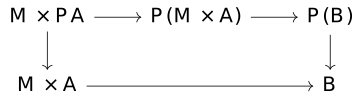
commutes. Now we must show the map A \to PM \times A \to P(M \times A) \to PB \to B is a P-homomorphism. Write E_A,E_B for the structure maps of the two algebras. Consider this diagram:
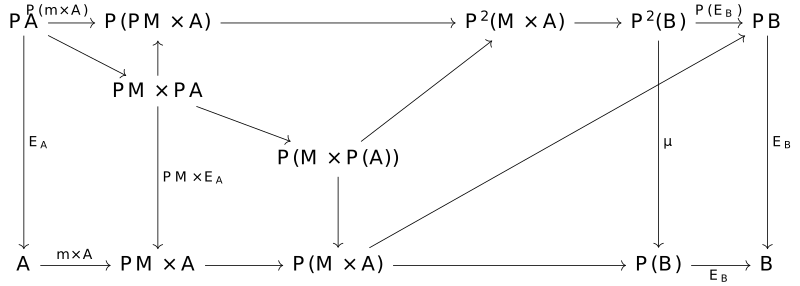
The triangle at the top left commutes because P is strong. The square to the right does not commute in general---however, since P is commutative, the composite maps PM \times PA \to P^2(M \times A) \xrightarrow {\mu } P(X \times A) agree. Since the map P^2(M \times A) \to B factors over this, we may replace one edge of this square with another. The square to the right of that is simply P(-) applied to the previous diagram, and so commutes by assumption. The "triangle" under that is just two copies of the same maps, so commutes. The square on the left of the diagram commutes by functoriality of product. The square to the right of that commutes again because P is strong. Hence the outer square commutes, which is precisely the homomorphism property we wanted.
It is apparent that, if A, B = P_XA', P_B' are free algebras, this restricts to the stochastic module structure of \mathcal {C}^\to |_\mathrm {det} (viewing \mathcal {C} as the Kleisli category of P). But since every algebra is a coequalizer of free algebras, it follows that the action on general algebras is determined uniquely by this. This implies the equations of a stochastic module.
As in Example [efr-TO9K], this cannot be expected to come from a Markov prefibration in general.
The vast majority of examples seem to occur as subcategories of stochastic modules of the form given by Proposition [efr-O6GQ] (of course, \mathcal {C}^\to is just the subcategory spanned fiberwise by the free algebras). In fact, since a stochastic module necessitates in some sense an action of P on the objects of the fiber, it seems they do all have this form in a generalized way, although we have not found a better way to make this precise than the existing definition of stochastic module.