Limits of Markov fibrations
[efr-HWAZ]
Limits of Markov fibrations [efr-HWAZ]
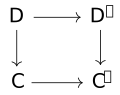
The class of fibrations is stable under pullback. This turns \mathsf {Fib}(-) into an indexed category, which represents a fibration over \mathsf {Cat}---this is the "global" category of fibrations \mathsf {Fib}, whose objects are fibrations \mathcal {D} \to \mathcal {C}, and whose morphisms are commutative squares
By considering universal constructions like limits and colimits in \mathsf {Fib}, additional fibrations can be constructed. It would similarly be useful to study limits in the category of Markov fibrations. Moreover, the products in \mathsf {Fib} allow one to express notions of internal pseudomonoid---these turn out to be monoidal fibrations, and this is a key part of Moeller and Vasilakopoulou's treatment of the monoidal Grothendieck construction, Reference [moeller-vasilakopoulou]. Since we want to study monoidal Markov fibrations, we should study their limits.
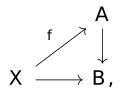
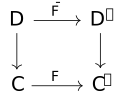
There is an obvious functor \mathsf {MarkPreFib} \to \mathsf {Fib} \times _\mathsf {Cat} \mathsf {Markov}^\mathrm {oplax}, which carries a prefibration to the pair of its Markov category and its underlying fibration onto the deterministic part. On each fiber, this admits a left adjoint, as constructed in § [efr-GO6R]. By abstract nonsense these left adjoints commute laxly with the pullbacks---that is, given an oplax Markov functor f: \mathcal {C} \to \mathcal {C}' and a map of fibrations \mathcal {D} \to \mathcal {D}' over the deterministic part, there is an induced functor \overline {\mathcal {D}} \to \overline {\mathcal {D}'} over f, although this assignment does not preserve Cartesian squares.
However this does give a functor \mathsf {Fib} \times _\mathsf {Cat} \mathsf {Markov}^\mathrm {oplax} \to \mathsf {MarkPreFib}, left adjoint to the restriction. The category of algebras over this monad is fibred over \mathsf {Markov}^\mathrm {oplax}, with each fiber being the category of stochastic modules over that markov category, and we get a global functor from \mathsf {MarkPreFib}. In the same way, we get a global functor \mathsf {SChart}(-) to \mathsf {Cat}^\to which carries each stochastic module \mathcal {D}_0 \to \mathcal {C}_\mathrm {det} \to \mathcal {C} to the functor \mathsf {SChart}(\mathcal {D}_0) \to \mathcal {C}
We would like to study the limits in here. At this point, we are forced to consider for a moment a bit of higher category theory. Structures on a category defined "up to isomorphism" generally don't play well together with limits in the category \mathsf {Cat}, since they are defined "up to equality". For example, we cannot infer from the fact that \mathcal {C},\mathcal {D} have products and the functors F,G: \mathcal {C} \rightrightarrows \mathcal {D} preserve them that the equalizer of F,G has products, since given A,B in the equalizer, we have F(A \times B) \cong G(A \times B), but not necessarily equality!
For the moment we will restrict ourselves to limits of strict (and in particular, strong) monoidal Markov functors, since these always exist. In general one should probably consider some form of homotopy limit, but we will not go into that now. We clearly have: