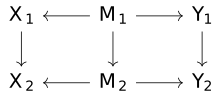
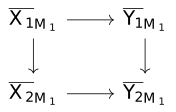
Definition [efr-RD28]
Definition [efr-RD28]
Let \mathcal {C} be a Markov category and let \mathcal {D} be a stochastic module over \mathcal {C}.
Let (M_1, \phi _1): \bar {X_1} \leftrightarrows \bar {Y_1}, (M_2, \phi _2): \bar {X_2} \leftrightarrows \bar {Y_2} be decorated spans in \mathsf {\mathbb Span}_{\mathcal {C}}(\mathcal {D} / \mathcal {C}_\mathrm {det}), and let f: \bar {X_1} \rightrightarrows \bar {X_2}, g: \bar {Y_1} \to \bar {Y_2} be morphisms in \mathcal {D}, so that we have a square
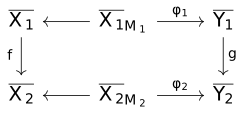
A 2-cell of decorated spans for this data consists of a morphism m: M_1 \to M_2 \in \mathcal {C} (that is, possibly stochastic), satisfying the following two conditions. First, the diagram