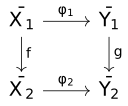
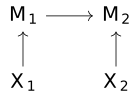
Double categories of stochastic charts and lenses [efr-SIE7]
Double categories of stochastic charts and lenses [efr-SIE7]
To construct the double category \mathsf {\mathbb Arena}(\mathcal {A}) of charts and lenses for an ordinary fibration \mathcal {A} \to \mathcal {C}, one can use the following procedure:
- Form the square double category \mathcal {A}^\to \rightrightarrows \mathcal {A}
- Take the fiberwise opposite of these objects: (\mathcal {A}^\to )^\mathrm {fop} \rightrightarrows \mathcal {A}^\mathrm {fop}.
- Observe that fiberwise opposite preserves pullbacks, and hence this is again a double category.
Here we used the following result: If \mathcal {D} \to \mathcal {C} is a Grothendieck fibration and \mathcal {A} is any category, then \mathcal {D}^\mathcal {A} \to \mathcal {C}^\mathcal {A} is again a fibration (which classifies the lax limits of the composite \mathcal {A}^\mathrm {op} \to \mathcal {C}^\mathrm {op} \to \mathsf {Cat}), and a natural transformation is Cartesian iff it is levelwise Cartesian. It would be neat to obtain a similar result for Markov fibrations.
The first problem with this is that \mathcal {C}^\mathcal {A} does not generally inherit a Markov structure from \mathcal {C}. As we noted when we introduced diagram Markov categories, one has to consider the category \mathsf {Fun}(\mathcal {A},\mathcal {C}) of deterministic diagrams instead.
First, we will see that this indeed works for Markov prefibrations. This implies that (-)^\mathcal {A} lifts from fibrations to stochastic modules.
The question is now
- If \mathcal {D} is a Markov fibration, we get a stochastic module structure on \mathcal {D}|_\mathrm {det}^\mathcal {A}---does it present a markov fibration?
- There is an induced map \mathsf {SChart}(\mathsf {Fun}(\mathcal {A},\mathcal {D}|_\mathrm {det})) \to \mathsf {Fun}(\mathcal {A},\mathcal {D}) (where the latter is taken by convention to mean the full subcategory of functors whose image in \mathcal {C} consists of deterministic arrows). Is this an isomorphism? (If it is, clearly this implies point 1)
Unfortunately it's not clear that either of these are true---the surjectivity of \mathsf {SChart}(\mathcal {D}|_\mathrm {det}) \to \mathcal {D} cannot a priori be lifted to the arrow category. The issue is that, given a map in \mathcal {D}^\to consisting of, say \phi _0,\phi _1, it is not sufficient to find charts representing each of these---we must find a chart of squares representing the square. This is not guaranteed by the Markov fibration structure, and a similar issue comes into play for the equivalence witnesses.
We may attempt to ignore this issue and simply try to form a double category \mathsf {SLens}(\mathcal {D}^\to ) \rightrightarrows \mathsf {SLens}(\mathcal {D}), given a stochastic module \mathcal {D}, but here the problem is that \mathsf {SLens} does not commute with limits in general. Hence we can not easily define a composition on the 2-cells of lenses obtained this way.
There are various ways we might attempt to remedy this problem. One approach would be to formulate a behavioural notion of "commutativity" for squares of stochastic lenses and charts, but the problem with this is that it is not obvious whether this property is stable under composition.
The basic problem stems from the fact that chart equivalences have a "directed" nature, and given a morphism of precharts (M,\phi ) \to (N,\psi ) and an equivalence (N,\psi ) \leftarrow (N',\psi ') (for example given by a stochastic section N' \to N satisfying suitable conditions), there is not in general a way to lift this back into an equivalent (M',\phi ') with a map to N'.
This observation leads to the idea that we might define a double category of precharts which has the directed equivalences among its morphisms (going only in one direction). We will begin by constructing this double category.
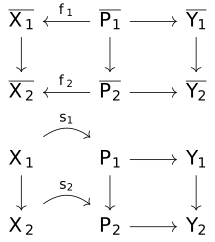
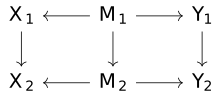
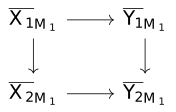
To spell it out, a 2-cell in \mathsf {\mathbb Span}_{\mathcal {C}'}(\mathcal {D} / \mathcal {C}) consists of a diagram of this form in \mathcal {D}, where f_1,f_2 are Cartesian,
and (writing X_1 for the object underlying \overline {X_1}, and so on) two sections s_1,s_2 of the underlying maps in \mathcal {C}', so that the second diagram also commutes in \mathcal {C}':
Naturally, we are interested in the case of \mathsf {\mathbb Span}_{\mathcal {C}}(\mathcal {D} / \mathcal {C}_\mathrm {det}) for a stochastic module \mathcal {D}. Then the decorated spans are representatives for stochastic charts. We will start by introducing a loosed notion of 2-cell for these spans, which combines the directed equivalences with the ordinary deterministic 2-cells of spans.
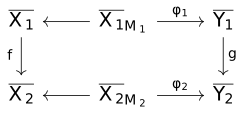
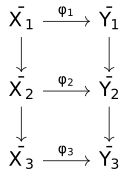
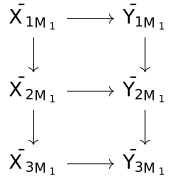
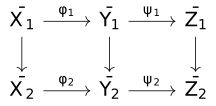
(The modification of everything above to lenses instead of charts is obvious).
In fact, the globular 2-cells are in a sense exactly the equations defining the set of charts:
The following straightforward lemma shows that charts over deterministic bases have initial representatives as spans. This will be important later: