Midpoint algebras and Coinflips [efr-AHFX]
Midpoint algebras and Coinflips [efr-AHFX]
We will not have any hope of giving a universal property for \mathsf {BorelStoch}, or any interesting Markov category, without some property that forces certain maps to be nondeterministic. We now give such a structure. As mentioned, our basic idea will be to impose the existence of a "unbiased binary random choice". In a general Markov category, this choice forms a morphism A \otimes A \to A. The axioms that such a choice must satisfy are essentially the axioms described by Escardo and Simpson in Reference [escardo-simpson-universal-interval-2001], which they termed midpoint algebras. The main theorem of their paper is a characterization of the interval [0,1] as the free iterable (Definition [efr-JP37]) midpoint algebra on two points—this will play a central role in this paper.
Note that if \mathcal {C} is Cartesian this agrees with the above definition.
Note that any coinflip structure is determined by the family of maps m(\pi _0,\pi _1) : A \otimes A \to A. To define a coinflip structure, such a family \mu _A must satisfy the equations of a midpoint algebra, be natural in A, and have the further property that \mu _A f = \mu _A (\pi _0 f, \pi _1 f) (that is, the composite depends only on the projections of f).
Coinflip structures are not preserved by all Markov functors, since F(\mu _A) only has to enjoy the above property with respect to maps in the image of F. However, as we now show, this is true in the distributive case.
Note that any coinflip I \to I + I in a distributive Markov category induces a coinflip structure, and vice versa. Since both notions are unique, this is obviously a 1-1 correspondence. From this we easily derive the following:
The terminology "midpoint algebra" is from Reference [escardo-simpson-universal-interval-2001]. In that paper, Escardo and Simpson provide a characterization of the interval as the free midpoint algebra satisfying certain properties generated by two points. The key property is the following:
Escardo and Simpson introduced the following notion:
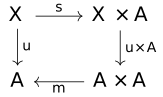
If A is an internal midpoint algebra in a category \mathcal {C}, a priori, the only version of Definition [efr-JP37] we can impose is that all the midpoint algebras \mathcal {C}(X,A) are iterable (in \mathsf {Set}). However, if \mathcal {C} is Markov, we can alternatively demand the following (which is just Definition [efr-JP37] with tensor products instead of products):
In this case we might call u an iteration operator for s.
Escardo and Simpson's theorem is that the set [0,1] is the free iterable, cancellative (i.e satisfying m(a,b) = m(a,c) \Rightarrow b = c) midpoint algebra on two generators. We now strengthen their theorem by proving that it is free among merely iterable midpoint algebras (since it cancellative, this implies their statement).
The situation with coinflip Markov categories is similar to the situation of preadditive categories, known for example from the study of homological algebra. Under mild conditions on a category (admitting finite products and coproducts is sufficient), an enrichment over commutative monoids is unique if it exists.
If the Markov category under consideration has at least countable coproducts, we may therefore simply speak of an iterable coinflip Markov category.