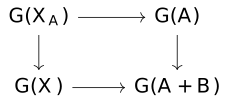
The Universal Property of Measure-Theoretic Probability › Distributive and extensive Markov Categories [efr-MGSE]
The Universal Property of Measure-Theoretic Probability › Distributive and extensive Markov Categories [efr-MGSE]
We will need to impose a few different categorical properties on our Markov categories. These are analogues of preexisting properties of ordinary categories, but will typically need to be modified somewhat to suit Markov categories. The usual pattern is to demand that \mathcal {C}_\mathrm {det} has some property, and that this is preserved by the inclusion into \mathcal {C}. In this section we will describe these conditions.
For background on extensive and distributive categories, see Reference [carboni-lack-walters-extensive]. For background on Boolean categories, see Reference [johnstone-elephant-vol1], section A1.4. Reference [chen-universal-stdborel-2019] also contains a review of these terms and the relations between them that suffices for this paper.
The list of hypotheses we will chiefly be interested in is the following:
- \mathcal {C}_\mathrm {det} is Boolean, countably complete and (countably) extensive (so that it receives a unique functor from \mathsf {Borel} by Chen's theorem).
- The inclusion \mathcal {C}_\mathrm {det} \hookrightarrow \mathcal {C} preserves the countable coproducts, the pullbacks along coproduct inclusions (hence all monomorphisms), and carries the countable products to Kolmogorov products.
There are various ways we can break this up into sub-assumptions. For example, if \mathcal {C} admits Kolmogorov products of a given cardinality, \mathcal {C}_\mathrm {det} admits products of that cardinality. So if \mathcal {C} has countable Kolmogorov products and \mathcal {C}_\mathrm {det} has pullbacks along monomorphisms, \mathcal {C}_\mathrm {det} has all limits.
In a distributive monoidal category, if A,B are each comonoids, then A+B acquires an induced comonoid structure given by A + B \to A \otimes A + B \otimes B \hookrightarrow (A+B)\otimes (A+B) If \mathcal {C} is a Markov category, each of these objects has furthermore a canonical given comonoid structure. \mathcal {C} is distributive as a Markov category if and only if the coproducts can be chosen so that the canonical comonoid structure coincides with the induced one.
This parametrization in a regular cardinal \kappa will recur a few times in this paper. We are chiefly interested in the cases \kappa = \omega , corresponding to finite coproducts, and \kappa = \omega _1, corresponding to countable coproducts (this case requires a weak form of the axiom of choice).
Note that any extensive Markov category is automatically distributive (for the same \kappa ). Note also that if \mathcal {C} is extensive Markov, then \mathcal {C}_\mathrm {det} automatically admits all finite limits, since it has finite products just by virtue of being a Markov category.
Recall that a coherent category is called Boolean if every subobject lattice is a Boolean algebra. Also note that an extensive category is Boolean (and coherent) as soon as it satisfies the condition that every monomorphism V \hookrightarrow X is a coproduct inclusion (the object V' so that A = V + V' is then the complement subobject of V). We will not need to study any other case than this, and so we simply make the following definition.
In the common case that \mathcal {C} is the Kleisli category of a monad on \mathcal {C}_\mathrm {det}, the inclusion \mathcal {C}_\mathrm {det} \hookrightarrow \mathcal {C} automatically preserves all colimits, which makes many of the above things automatic.