Bidirectionality in graphical models [efr-0002]
Bidirectionality in graphical models [efr-0002]
There is a significant existing literature (see Abstracting causal models, Reference [rischel_compositional_2021], Reference [rubenstein_causal_2017]. For a survey see Reference [zennaro_abstraction_2022]) studying transformations between structural causal models. These have generally been called something like abstractions, the typical examples being the relationship between a high-level and a low-level model of the same system. However, the precise properties that we should ask for in such a transformation have turned out to be somewhat subtle. The most obvious condition to impose is to ask, for any possible variable we could intervene on, say X, and any other variable (or collection of variables) Y, that the diagram
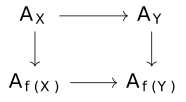
The main problem with this condition is that it is simply too strict. We generally can't ask that every low-level intervention is well-modeled by the corresponding high-level intervention. Rather, each high-level intervention corresponds to some distribution of the corresponding low-level variables, and we must ask that a diagram of this form:
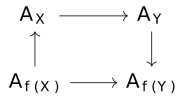
The key here is that control information flows in the opposite direction from measurement information. This phenomenon repeats in many examples.