Quantitative logic for systems [efr-001W]
Quantitative logic for systems [efr-001W]
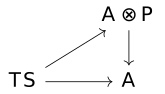
For discrete-time deterministic systems, a P = {\bar {P} \choose P}-valued predicate amounts to a mapping S \to P---since the diagram implies the update can't depend on the extra input \bar {P}, and in the deterministic case, a lift of S \to A over A \otimes P is simply a choice of S \to P. (In the non-deterministic case, this is not true, of course).
Let F: \mathsf {Set} \to \mathsf {Set} be a functor, and let \xi : X \to FX be a coalgebra of it. Then we can describe a predicate of X valued in P \in \mathsf {Set} as simply a function \phi : X \to P. Note that this makes X a coalgebra of F(-) \times P, and as such it has a unique map to the terminal coalgebra (if it exists) of this functor X \to (F(-) \times P)^\infty .
This means, given a predicate on that terminal coalgebra, p: (F(-) \times P)^\infty \to P, by composing these two operations, we get a new predicate on X. Thus, predicates on these cofree coalgebras are a sort of "modal operators"---for example, if P = \{\bot ,\top \} is the set of booleans, and F(X) = X (so that coalgebras are just discrete dynamical systems), the cofree coalgebra on P is the set \{\bot ,\top \}^\omega of streams of booleans. Then we can take p((\phi _i)) to be true if and only if each \phi _i is true. Then the modal operator of p is essentially "necessity"---the composite predicate is true for exactly those x \in X so that \phi (x_n) is true for every x_n on the trajectory.
In good cases, there will be a monadic adjunction associated to the lens A' \leftrightarrows A, and so this operation will give an endomorphism on predicates for each choice of lift of the cofree predicate (it can of course lift as itself, which corresponds to the identity operation).