Stochastic Categorical Systems Theory (The Discrete Case) [efr-001B]
- June 24, 2024
-
Eigil Fjeldgren Rischel
Stochastic Categorical Systems Theory (The Discrete Case) [efr-001B]
- June 24, 2024
- Eigil Fjeldgren Rischel
It will be instructive to work out the theory in the discrete case, which is to say, for the Kleisli category of the discrete (i.e finite-support) distribution monad on \mathsf {Set}. Note that even for discrete-time discrete-space applications, this setup is not really adequate, as we lack the structure to construct terminal systems.
Definition [efr-001C]
- June 24, 2024
-
Eigil Fjeldgren Rischel
Definition [efr-001C]
- June 24, 2024
- Eigil Fjeldgren Rischel
Let \Delta : \mathsf {Set} \to \mathsf {Set} carry a set X to the set of finite-support probability distributions on X. Recall that \Delta is a monad.
Given two indexed sets \bar {X} \to X, \bar {Y} \to Y, an indexed stochastic lens \binom {\bar {X}}{X} \to \binom {\bar {Y}}{Y} is an element of the convex space \prod _{x \in X} \sum _{y \in Y} [\Delta (\bar {Y}_y),\Delta (\bar {X}_x)], where the internal hom, product and coproduct are taken in the category of convex spaces. Note that if each \bar {Y}_y is identical, say B, this is isomorphism to \prod _{x \in X} \Delta (Y) \otimes [\Delta (B),\Delta (\bar {X}_x)]. Recall also that an element of [\Delta (X),\Delta (Y)] is equivalently a function X \to \Delta (Y), i.e. a Kleisli map X \to Y.
An indexed stochastic chart is an element of the convex space \prod _{x \in X} \sum _{y \in Y} [\Delta (\bar {X}_x),\Delta (\bar {Y}_y)]
Proposition [efr-001D]
- June 24, 2024
-
Eigil Fjeldgren Rischel
Proposition [efr-001D]
- June 24, 2024
- Eigil Fjeldgren Rischel
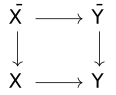
The set of indexed stochastic charts is just the set of commutative squares in \mathsf {Kl}(\Delta ) of this form:
Proof
- June 24, 2024
- Eigil Fjeldgren Rischel
Proof
- June 24, 2024
- Eigil Fjeldgren Rischel
where this exponential denotes the iterated Cartesian product in convex spaces. An element of this set clearly gives a commutative square, because for each y \in Y, there is a square which deterministically chooses that y, and uses the given family of distributions on \bar {Y}_y depending on \bar {X}. This mapping is injective, since each map \bar {X} \to \Delta (\bar {Y}_y) can be recovered as a conditional distribution, and the convex combination of ys is merely the underlying distribution on Y. On the other hand, by choosing conditional distributions, it is also seen to be surjective, finishing the proof.