Random thoughts on universal/synthetic probability theory [efr-RI1E]
Random thoughts on universal/synthetic probability theory [efr-RI1E]
The study of "probability theories with universal properties" (that is, Markov categories which are initial in some sense). There are two central types of questions:
- Can we give universal properties to existing Markov categories of interest?
- Can we characterize the initial Markov category with some given properties/generators?
This may be said to belong to "metatheory", that is the study of initial models of various type theories, although the existence of nondeterministic maps, and of infinitary (Kolmogorov) products, changes its nature somewhat.
See eg The Universal Property of Measure-Theoretic Probability (also on arxiv) for a result along these lines.
Techniques like this allow you to control some subset of maps 2^K \to A being composed with coinflips. In the case of \mathsf {BorelStoch}, this appears to be enough as every measurable map is generated by the finitary ones and the countable disjunction \vee : 2^\omega \to 2 (by looking at \limsup : 2^\omega \to 2, which is necessarily less than \vee but can have the lemma apply to it, by taking d = \vee : 2^2 \to 2 and s to be the coordinatewise negation). Thus it appears that the initiality of \mathsf {Borel} is one of the key reasons why we can control all its maps interactions with coinflips without further axioms.
Since the map \limsup : 2^\omega \to 2 is not continuous, nor even continuous or computable in some weak sense (for example, the map 2^\omega \to \Omega , the space of truth values, is still not continuous, it is not even semidecidable, etc), we may want to study models of probability which prohibit this map. It is an interesting problem how to carry out the argument above without it. The objective would be to apply a proof to \vee : 2^\omega \to 2, whose composite with 2 \to \Omega is at least continuous (and it's semidecidable, etc). Since this is not independent of finite prefixes, we cannot apply the Kolmogorov 0-1 law in this case. We can apply Hewitt-Savage 0-1 law if we assume the Markov category is also causal.
It seems plausible that freely coinflip-complete Markov categories may always be causal, since we add "no extra equations", (similar to how multiplication is always injective in free monoids, but not in a generic monoid), but it is not obvious how to prove this.
Perhaps an even simpler thing to start with would be whether these completions are positive, which is after all weaker than causality.
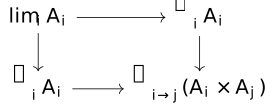
The lemma which is required in the proof of the Hewitt-Savage 0-1 law (which follows from causality, but is not equivalent to it, as far as I can see) is true whenever \mathcal {C}_\mathrm {det} has equalizers and the pullback
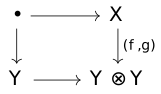
Hence given this level of limits, we can use the hewitt-savage argument to prove determinism for \vee : 2^\omega \to 2.
Much seems to revolve around some class of deterministic monos such that pullbacks along these exist and are preserved by \mathcal {C}_\mathrm {det} \hookrightarrow \mathcal {C}. We should give a "syntactical" understanding of this rather than saying "monos with property X also do this" (eg X = extremal or something).
From a programming/type theory point of view, the sensible thing is not to talk about deterministic morphisms, but to have a subsyntax for "pure" morphisms and speak of this category. And then have a statement that in the initial models all the deterministic maps are pure. This would necessitate modifying/rethinking the proof that \vee f^\omega = 1.
A meta-principle, which you can hope to be true, is this: Given \hat {f}: 2^\omega \times A \to B in a Cartesian category representing f: A \to B in a coinflip completion, if f is deterministic, then there exists (at least one, but probably a set of full measure) b \in \{0,1\}^\omega (an actual bitstream, not in \mathcal {C}) so that \hat {f}(b,A) = f (and in particular f is already in the Cartesian category under consideration).
This is essentially the key part of my proofs in the universal property paper. The hard part in applying this obviously is proving that these maps exist, but also in proving that the limiting map actually exhibits the identity that you want. There we usually have to observe that it does on some measure-1 subset of the sample space, which is enough.
The specific pullbacks that have to be preserved is a bit unclear. It would be nice if they could all be deduced from the Kolmogorov property along with the assumption that decidable subsets/coproduct inclusions have this property.
Is there a subobject version of the Kolmogorov or Hewitt-Savage 0-1 laws? It would state something like "given a subobject V \subseteq X^{\otimes \mathbb {N}} which is invariant under finite permutations, and an IID measure \mu : P \to X^\mathbb {N}, dots". Unclear what the statement should be - can't expect "either factors or factors over complement", since that requires decidability kind of.
There may be some way of stating this, in terms of whether two independent copies of the measure belong to the set or not. What I really want is: if two sets both have this property, then any measure which is concentrated on their union is also concentrated in one of them(??).
Possibly something like this would work for split monos, (maybe just by applying the splitting to the existing theorem). However the inclusion of streams with one 1 in all streams is not split (?).
But I think the map \sum _n \{b \in 2^\mathbb {N} \mid b_n = 1\} \to \{b \in 2^\mathbb {N} \mid \exists n: b_n=1\} does split (it's an epi) (under very mild assumptions, weaker than elementary topos+NNO). And I think this gives us a chance, since the former is a decidable subset of \mathbb {N} \times 2^\mathbb {N}.
If we believe this theorem, then this is a sheaf topos model of probability where all pullbacks are preserved.
Instead of the Kolmogorov products axiom, we can consider the axiom that if a random truth value \phi satisfies \phi \leq \phi / 2 (defined in the obvious way in terms of the coinflip) then \not \phi (this should probably be a positive statement instead, although at the moment the right formulation escapes me). This relies on there existing a reasonable ordering on random truth values obviously. I'm attracted to this formulation because it's more finitary, and because it is reminiscent of the axiomatics for synthetic guarded domain theory.
I think this, like a lot of other stuff, is not a consequence of the Kolmogorov axiom but only admissible, that is it is true when \phi can be constructed inductively from the clopens in 2^\omega but not in full generality. However I don't know of any counterexample proving this, and as I've noted before, the combination of Kolmogorov products with any amount of nondeterminism seems to rule out certain types of "discontinuous maps".
Tao's old blog post on "probability sheaves" may be interesting. My old problem with that is that it only depends on which sets have probability one or zero. But the ideas developed here shows you can do a lot once you can prove that certain sets must have probability 1!
I have previously thought that "synthetic probability theory", unlike SDG (for example), doesn't involve any "exotic stuff" in the models (like the infinitesimals in SDG). (That is, we can construct models that have some exotic stuff if we want to, but we have no need of them or advantages in them). I think I have discovered at least one "exotic gadget" of this type. That is, take the sheaes on Borel spaces model above. Then "the union of all Lebesgue measure zero subsets of [0,1]" is an object which itself has measure zero in a relevant sense (maybe. Or at least, it has no positive measure..), which you could not construct classically.
We would like to prove, for example, a metatheorem like this: in the initial model, given a collection of sets U_q indexed by \mathbb {Q}_{< \alpha } for some Dedekind real \alpha , so that their probabilities are p_q, with q < r \Rightarrow U_q \subseteq U_r, then the probability of \cup _q U_q is \sup p_q.
It would actually be fine to just prove that in the initial model, distributions on finite sets n are represented by the internal Dedekind simplex \{t_1,\dots t_n \mid \sum _i t_i = 1\}. (We have already constructed [I hope] the supposed sampling map \Delta ^n \nrightarrow n and shown it is "homomorphism" in a suitable sense, but not proven it is universal [which should only hold under some initiality assumption])
Let \mu : \Gamma \nrightarrow [0,1] be a measure. Call e: \Gamma \to [0,1] an superexpected value of \mu if, for every finitary decomposition \mu = \sum t_i\mu _i, \sum _i t_i = 1, t_i: \Gamma \to [0,1], \mu _i : \Gamma \nrightarrow [0,1], and every set \alpha _i so that \mu _i \geq \alpha _i almost surely, we have e \geq \sum _i t_i \alpha _i. Analogously define subexpected values. Say an expected value is a super- and subexpected value. Question: is there always a unique expected value? Idea: try to turn this into a Dedekind cut.
Consistency: is it clear there is no measure on the empty set? Yes because we have a model.
Idea: bring metrics into the induction hypothesis. Cook up a model where objects are types, a regularly complete convex metric space where every point has distance at most one (then the coproducts of points put things at distance one), and a map from (generalized) points in this space to distributions. The tensor product of these guys should give us the right thing.
Formally an object should be a type X, a internal, complete barycentric algebra M (that is, an internal convex space, which is a metric space, complete as such, and where the metric satisfies the equations of a barycentric algebra) satisfying further d \leq 1, and for each context (that is, type) \Gamma a function \mathcal {C}(\Gamma , M) \to \mathcal {C}_s(\Gamma , X). (Here if we are working with a model where distributions are a monad, rather than just a promonad, we should restrict distribution types from occuring in the context). Furthermore we should ask for these to be equipped with a coalgebra structure for the completed tensor product on these things (which we have to show exist constructively!), and consider coalgebra homomorphisms (so that the Cartesian product on the distribution part becomes the tensor product).
We can derive "sequential completeness", that is the ability to take well-defined infinite sums, just from the convexity and the inverse limit property (we get a well-defined map from \lim _\leftarrow \Delta ^n to P(n^\infty ), distributions on the conats). I guess something similar would work for other profinite sets.
I guess the idea is we slowly build up a set of results like this, until algebras for this are "enough" that we can glue them to the space of distributions and get a model.
Let f,g be as in Idea for proof of "convexity" for generic probabilities . Then the limiting permutation \sigma ^{\alpha } : (2^\mathbb {N})^2 \to 2^\mathbb {N} can be written as the dyadic expansion of b : b < \alpha , \alpha + (1-\alpha )b' : b > \alpha , which exists because these numbers differ from every dyadic rational with probability 1. The challenge is to prove constructively that this dyadic expansion is uniform, i.e if the two input sequences are sampled uniformly, so is the output sequence. It is not even clear how to show that the first bit is fair, let alone that every prefix is fair.
Suppose we can define some reasonable probability monad on some topological topos (maybe pyknotic sets). Then we can attempt the following "glue model": an object is a type, a topological space and a map to the global sections (and maps must preserve this). (A map from the global points of the space to the global sections, or what?), and an analogous map from global points of PX to distributions in the initial model. (Maybe this latter is all we need).
nlab: locale of real numbers contains the following observation: if all reals are contstructible, then the interval has measure zero (since it can be covered by arbitrarily small unions of countable intervals). This can be avoided by working with the locale of reals, where even though every point can be covered, this cover doesn't necessarily cover the whole interval. This problem doesn't necessarily come up in minimal models as the one I've considered (since there this cover doesn't exist because it's not possible to construct it [every real is computable but this is not internally true]), but it still seems important to ponder what it means.
I have convinced myself that it is not possible to sample with Dedeking real probability using only the sequential cofiltered limits axiom (and thus also the "strong iterability" property, that if two measures approximate each other arbitrarily well they must be equal, must fail). I think this can be seen by considering a model \operatorname {\mathcal {S}\mathrm {h}}(\mathbb {R}, \operatorname {\mathcal {S}\mathrm {h}}(\mathsf {Borel})), where we recall that in sheaves on the reals, the Cauchy reals are the locally constant ones but the Dedekind reals are the continuous ones. I think this should carry a model where the distributions on a locally constant set themselves form a locally constant set. (Note that we add the measurable stuff to make it easier to construct any model at all, but I think this doesn't make a huge difference).
Thus the open questions are:
- Is the weak/sequential form of iterability still admissible?
- Does at least the proof of convexity for Cauchy reals go through (I think it does)? (And also sampling with Cauchy probability, for that matter)
- Is there a modified version of the Kolmogorov axiom which lets you sample Dedekind reals? I don't see how at this moment. (Of course, you can add the strong iterability condition as a further axiom.)
- Can you sample with Escardo-Simpson probability? Recall that these are the Cauchy closure of the rationals inside the Dedekind reals, i.e not just limits of rational sequences, but limits of sequences of such, iterated. This follows from iterability by the work of Escardo-Simpson.
- If you can sample with probability p_i, can you sample with probability \sum _i 2^i 1/p_i? Note that there is an obvious way to do something that should be this, but I don't know if we can prove this is equal to the probability of being less that that number (without countable choice). And if yes, does this imply the previous? (In other words, given a Cauchy sequence of reals, can you write their limit as a sum of (say) rational combinations of them, without using countable choice?)
For this last step, here's the loose argument that given a Cauchy sequence of rationals we can build a sampling plan:
- Let q_n be the sequence, supposing q_n within 1/2^n of the limit.
- Consider q_3 (which is within 1/8). It's in either [ 0, 3/8 ), [3/8, 5/8], ( 5/8, 1 ]. Note that this is decidable. We can either choose the first thing in the sum to be 0 (since it's definitely less than 1/2), 1/2 (since it's at least 1/4 and at most 3/4 in the middle case) or 1.
- Then we iterate this.
You can try to take (q_n - 1/2^n) for some n as the first term in the sum. The problem with this is that if it's less than zero, we just know the limit might be zero (so we can't put a positive number in the sum). If it's less than zero obviously we can just put zero (since the whole thing is less than 1/2 then), but this is not decidable, and if there are multiple options we have to choose one.