This definition of Markov category is a categorical structure placed on top of a symmetric monoidal category, in an analogous way to how a symmetry is an extra structure on top of a monoidal category. Although it is rarely an issue in practice, the set of equations involved in the definition is somewhat unwieldy. However, they can be simplified greatly by the observation that \mathcal {C}_\mathrm {det} must be Cartesian. Since the diagonal map in a Cartesian category is uniquely picked out by a universal property, specifying \mathcal {C}_\mathrm {det} therefore suffices to specify the Markov structure on \mathcal {C}. Let us formalize this observation:
Let \mathcal {C} be a symmetric monoidal category. A premarkov structure on \mathcal {C} is a wide symmetric monoidal subcategory \mathcal {C}' \subseteq \mathcal {C}---that is, a class of morphisms which contains all identities and structural isomorphisms, and is stable under composition and monoidal products---so that the monoidal category \mathcal {C}' is Cartesian.
Given a premarkov structure\mathcal {C}' \subseteq \mathcal {C}, there is a unique Markov structure on \mathcal {C} so that each morphism in \mathcal {C}' is deterministic.
Given a Markov structure, \mathcal {C}_\mathrm {det} \subseteq \mathcal {C} is a premarkov structure.
A premarkov structure has the form \mathcal {C}_\mathrm {det} for some Markov structure if and only if it is maximal.
The existence part first claim is clear: \mathcal {C}' acquires a unique Markov structure since it is Cartesian, and the inclusion of that Markov structure into \mathcal {C} gives a Markov structure on \mathcal {C}. Conversely, suppose \mathcal {C} is a Markov category and \mathcal {C}' \subseteq \mathcal {C}_\mathrm {det} is a class of deterministic morphisms which is still Cartesian. This means the projections X \otimes Y \to X,Y still exhibit X \otimes Y as a product in \mathcal {C}'. But since the pairing are the unique map lifting two given maps A \to X,Y, the pairing must be preserved by the inclusion \mathcal {C}' \to \mathcal {C}_\mathrm {det}. Since the canonical Markov structure is given as a pairing, this means the markov structure induced by \mathcal {C}' \to \mathcal {C} must agree with the one given by \mathcal {C}_\mathrm {det}, which is just the original one.
Now suppose \mathcal {C}_\mathrm {det} \subseteq \mathcal {C}' \subseteq \mathcal {C}, where \mathcal {C}' is some larger premarkov structure. By the argument above, they must generate the same Markov structure on \mathcal {C}. But again, this implies that every map in \mathcal {C}' is deterministic for this Markov structure, so we have \mathcal {C}_\mathrm {det} = \mathcal {C}'. This finishes the proof.
Given the preceding proposition, an alternative definition of Markov category could be a symmetric monoidal category equipped with a maximal Cartesian wide (monoidal) subcategory. In addition to thus simplifying the definition, it also removes the need to manually verify the equations.
The proposition above seems to have first appeared in my PhD thesis, § [efr-0001]. However the basic idea has circulated as folklore for some time. In particular, the idea has been suggested independently by several people of viewing Markov categories as particular monoidal double categories, where the tight category is Cartesian. The premarkov structures above are essentially a special case of this idea.
The obvious notion of Markov functor is some type of symmetric monoidal functor which preserves the duplication map. Since oplax monoidal functors are the ones that preserve comonoids, this is the obvious possibility.
However, with Proposition [efr-10HQ] in hand, the following definition also suggests itself: a Markov functor is a symmetric monoidal functor which preserves deterministic maps. Recall that any functor between Cartesian monoidal categories automatically acquires an oplax monoidal structure. The only subtlety here is that the induced oplax structure is not necessarily compatible with the whole monoidal category. This leads to the following:
Let F: \mathcal {C} \to \mathcal {D} be a functor between Markov categories.
If F is a Markov functor, it preserves deterministic maps. The oplax monoidal structure on F is necessarily given by the unique one induced on F_\mathrm {det} : \mathcal {C}_\mathrm {det} \to \mathcal {D}_\mathrm {det}.
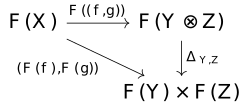
Moreover it preserves independent pairings, in the sense that
commutes, where \Delta is the oplax monoidal structure.
Given a functor F': \mathcal {C} \to \mathcal {D} which preserves deterministic maps and independent pairings in this sense, the comonoid structure on F'_\mathrm {det} makes F into an oplax Markov functor.
A Markov functor is strong if and only if F_\mathrm {det} preserves products.